A comprehensive guide to improving your business visibility across ChatGPT, Google AI Overviews, Gemini, Perplexity and Microsoft Copilot.
The way people search for information, discover businesses and make purchasing decisions is fundamentally changing.
For years, businesses have focused on achieving high rankings on Google. Today, potential customers are increasingly turning to artificial intelligence to research products, compare service providers and receive personalised recommendations.
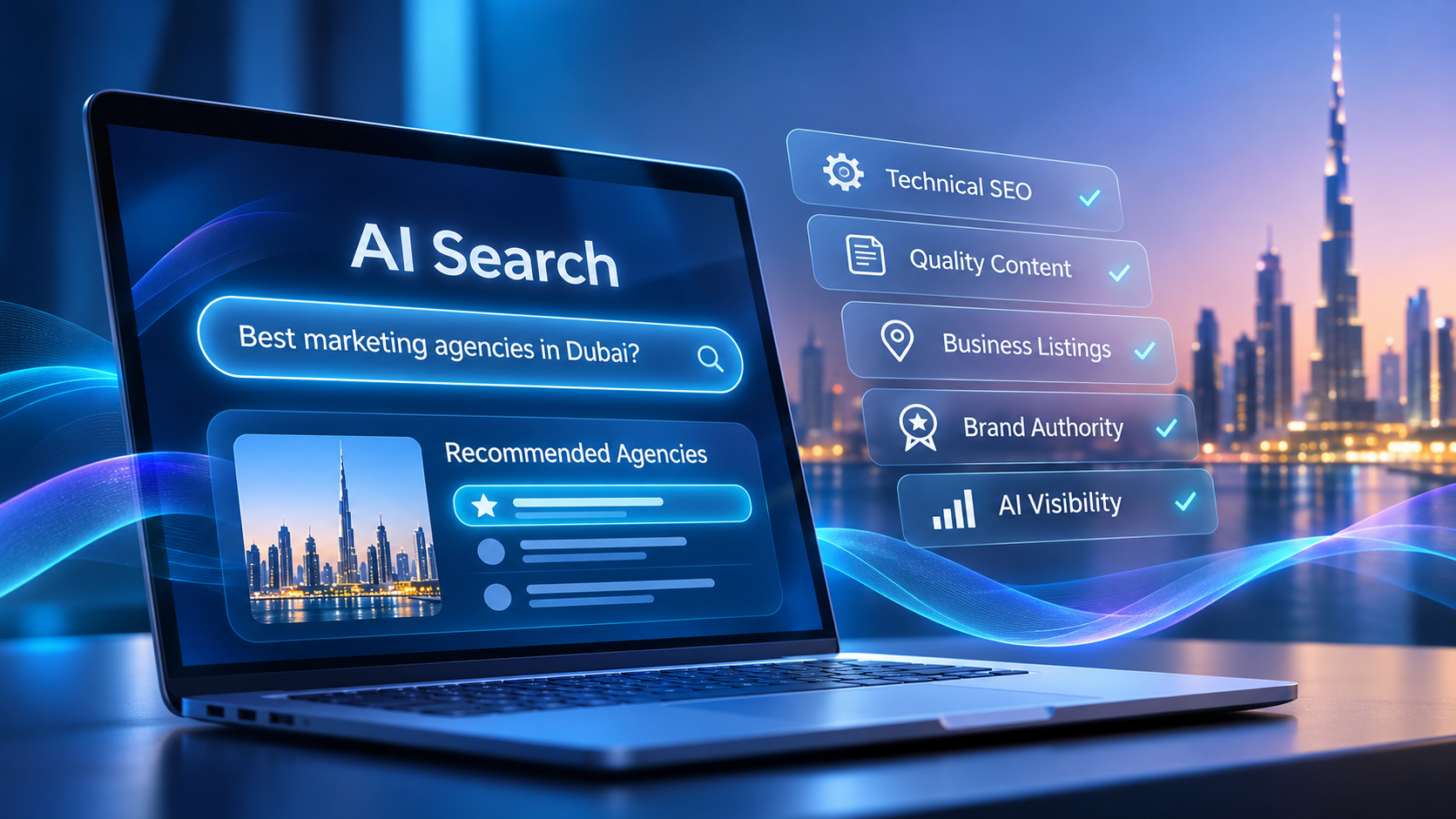
Instead of entering a few keywords into a traditional search engine, users are asking conversational questions such as:
- What are the best digital marketing agencies in Dubai?
- Which companies specialise in cinematic AI video production?
- Who are the leading marketing consultancies in the UAE?
- Which agency has experience working with international brands?
- What is the best marketing strategy for a business entering a new market?
Rather than presenting a traditional list of websites, AI search platforms can generate comprehensive answers, compare companies and recommend specific businesses.
For business owners and marketing professionals, this raises an important question:
How can you improve the likelihood of your business being discovered, referenced and recommended by AI search engines?
At Omnireach Digital, we have been actively researching this evolving search landscape, optimising our own digital ecosystem and testing how artificial intelligence discovers and recommends businesses.
Our experience has highlighted an important distinction: having a professionally designed, technically optimised and indexed website does not automatically mean your business will appear in AI recommendations.
Achieving greater visibility requires a broader approach that combines technical SEO, content strategy, structured data, business listings, digital PR and brand authority.
This guide explains how to implement that approach.
Table of Contents
- Understanding SEO, AEO and GEO
- How AI search engines discover businesses
- Conducting a technical website audit
- Optimising robots.txt and AI crawler accessibility
- Google Search Console and Bing Webmaster Tools
- Structured data and schema markup
- Optimising website content and service pages
- Image SEO, filenames and alt text
- Case studies, testimonials and professional expertise
- Business listings and online directories
- Digital PR, backlinks and external authority
- Social media and YouTube optimisation
- ChatGPT Business Agents and emerging AI tools
- Testing your AI search visibility
- Measuring performance and business impact
- Common AI search optimisation mistakes
- Your 30, 60 and 90 day implementation roadmap
- AI search optimisation checklist
- Frequently asked questions
1. Understanding SEO, AEO and GEO
Artificial intelligence has introduced new terminology into the digital marketing industry. Three concepts are particularly important for businesses looking to improve their online visibility.
SEO: Search Engine Optimisation
SEO focuses on improving the visibility of a website within traditional organic search results.
It includes technical website optimisation, keyword research, content development, internal linking, backlink acquisition, website performance and user experience.
The objective is to help search engines understand, index and rank relevant website content.
SEO remains the foundation of digital discoverability. Businesses should not abandon their existing SEO strategies simply because AI search is becoming more prominent.
AEO: Answer Engine Optimisation
Answer Engine Optimisation focuses on structuring content so that it provides clear, accurate and useful answers to specific questions.
For example, instead of publishing a general page about marketing services, a business might address questions such as:
- What does a digital marketing agency do?
- How much does AI video production cost?
- How long does a performance marketing campaign take to generate results?
- What should businesses consider when selecting a marketing agency?
Content that directly addresses customer questions can support visibility across traditional search features, voice assistants and AI generated answers.
GEO: Generative Engine Optimisation
Generative Engine Optimisation focuses on improving the likelihood of a business, product, service or piece of content being referenced within AI generated responses.
Unlike traditional SEO, where businesses primarily compete for positions within a search results page, GEO considers how generative systems discover, interpret and present information.
This may include information from company websites, industry publications, business directories, customer reviews, news articles and other publicly accessible sources.
SEO, AEO and GEO are not competing disciplines. They are complementary components of a modern digital visibility strategy.
2. How AI Search Engines Discover Businesses
AI search engines do not all operate in the same way.
Some systems retrieve information from live web searches, while others combine search indexes, previously learned information, specialised databases and external data providers.
When a potential customer asks an AI platform to recommend a business, the system may consider information from multiple sources.
These can include:
- Official company websites
- Search engine indexes
- Business directories
- Industry publications
- Customer reviews
- Professional profiles
- News coverage
- Publicly available case studies
- Product and service information
- Relevant third party references
The exact selection and recommendation processes differ between platforms and are not fully disclosed.
However, businesses can improve the quality, accessibility and consistency of the information available about them.
Consider two companies offering similar services.
The first has an attractive website but provides limited information about its experience, management team, clients and completed projects. It has few external references and incomplete business listings.
The second has a technically accessible website, detailed service pages, published case studies, authentic client reviews, consistent business listings and relevant industry coverage.
The second company provides a richer collection of information that search platforms can potentially discover and use.
This does not guarantee that it will receive more AI recommendations, but it creates a stronger foundation for digital discoverability.
3. Conduct a Comprehensive Technical Website Audit
Before investing in content marketing or digital PR, businesses should ensure that their websites are technically accessible.
A website may look excellent to visitors while containing technical issues that prevent search engines from properly accessing or understanding its content.
A comprehensive technical audit should include:
- Website indexing status
- XML sitemap configuration
- Robots.txt settings
- Canonical URLs
- HTTPS security
- Mobile responsiveness
- Website loading speed
- Broken internal and external links
- Redirect errors
- Duplicate page titles
- Missing meta descriptions
- Missing image alt text
- Incorrect heading structures
- Accidental noindex directives
- Firewall and hosting restrictions
For WordPress websites, SEO plugins such as Rank Math can help identify and manage many of these issues.
However, an SEO plugin is a tool, not a complete optimisation strategy.
Businesses must still review individual pages, validate technical settings and ensure that their website communicates useful and accurate information.
Our experience at Omnireach Digital
As part of our own optimisation process, we reviewed website accessibility, duplicate page titles, image alt text, structured data and search engine indexing.
We also used Bing Webmaster Tools to assess website indexability and identify potential technical SEO issues.
These checks helped establish a stronger technical foundation. However, subsequent AI search tests demonstrated that technical accessibility alone was not sufficient to consistently secure recommendations.
This is why technical SEO should be treated as the starting point rather than the final objective.
4. Optimise Your Robots.txt File and AI Crawler Accessibility
The robots.txt file provides instructions to web crawlers about which areas of a website they may access.
It is normally available at:
yourwebsite.com/robots.txt
Incorrect configuration can unintentionally restrict search engines from accessing important website pages.
Businesses should review whether relevant search crawlers can access their publicly available content.
Examples include:
| Crawler | Purpose |
|---|---|
| Googlebot | Google search crawling |
| Bingbot | Microsoft Bing search crawling |
| OAI-SearchBot | OpenAI search discovery |
| GPTBot | OpenAI crawling for potential model training |
| PerplexityBot | Perplexity search crawling |
It is important to distinguish between search discovery and AI model training.
Allowing a search crawler to access your website does not necessarily mean that you must also allow crawlers associated with model training.
Businesses should make these decisions according to their intellectual property, privacy and content policies.
Review more than robots.txt
Crawler access can also be affected by:
- Hosting security settings
- Web application firewalls
- Content delivery networks
- Automated bot protection
- Password protected pages
- Server response errors
- Website content that requires JavaScript to become accessible
A correctly configured robots.txt file does not guarantee that every crawler can successfully retrieve your website.
Use available webmaster tools, server logs and technical testing to investigate accessibility problems.
5. Register and Monitor Your Website With Google and Bing
Many businesses focus almost exclusively on Google when managing their organic search presence.
However, the broader search ecosystem is increasingly important as AI platforms use different combinations of search indexes and retrieval technologies.
Google Search Console
Google Search Console allows website owners to monitor how Google discovers and indexes their content.
Businesses should use it to:
- Submit their XML sitemap
- Inspect important website URLs
- Identify indexing problems
- Monitor organic search impressions and clicks
- Review search queries
- Identify technical issues
- Request indexing after significant content updates
Google’s generative search experiences are supported by its existing search infrastructure. Maintaining strong traditional SEO fundamentals therefore remains essential.
Bing Webmaster Tools
Bing Webmaster Tools provides additional opportunities to monitor website discoverability.
Businesses can use the platform to submit sitemaps, inspect URLs, identify SEO issues and review available search and AI visibility insights.
At Omnireach Digital, reviewing our website through Bing formed an important part of our technical optimisation process.
We recommend regularly inspecting your most valuable service pages, case studies and newly published articles across both Google and Bing.
A submitted sitemap helps search engines discover URLs, but it does not guarantee that every page will be indexed.
6. Implement Structured Data and Schema Markup
Structured data provides search engines with additional context about the information published on a website.
While human visitors can understand a company profile by reading its content, structured data helps machines interpret specific relationships and attributes.
Depending on your business, relevant schema types may include:
| Schema type | Purpose |
|---|---|
| Organization | Company identity and official information |
| LocalBusiness | Relevant local business details |
| Service | Information about professional services |
| Person | Management team and author information |
| Article | Editorial and educational content |
| BlogPosting | Blog articles |
| VideoObject | Published video content |
| BreadcrumbList | Website navigation hierarchy |
| Product | Product information |
Organisation schema
Organisation schema can communicate important information about a business, including its official name, website, logo, contact information and associated online profiles.
The sameAs property can be used to identify official profiles representing the same organisation.
These may include LinkedIn, Instagram, Facebook and YouTube.
During our own website optimisation, we reviewed our organisation schema and its connections to Omnireach Digital’s official digital channels.
This helps create a more consistent representation of our business across different platforms.
Validate your structured data
Businesses should use tools such as the Schema Markup Validator and Google’s Rich Results Test to identify relevant implementation errors.
Structured data must accurately reflect the information available on the website.
Do not add fabricated reviews, unsupported ratings, misleading business information or schema properties that do not represent your actual services.
Schema markup improves machine readability and can support eligible search features. It does not guarantee higher rankings or inclusion in AI recommendations.
7. Optimise Your Website Content and Service Pages
One of the most common problems with corporate websites is the use of generic marketing language.
Statements such as “We create extraordinary experiences” or “Your success is our success” may communicate brand values, but they provide limited information about what a company actually does.
Compare the following examples.
Generic headline:
We bring your vision to life.
Descriptive headline:
Cinematic AI Video Production for Businesses in Dubai and the UAE.
The second headline communicates a specific service, target audience and geographical market.
This makes it more useful to potential customers and easier for search systems to interpret.
Create dedicated service pages
Rather than combining all services into a single page, businesses should consider creating comprehensive pages for their main areas of expertise.
For example, a strategic marketing agency might have dedicated pages covering:
- Strategic marketing consultancy
- Performance marketing
- Search engine optimisation
- AI video production
- Social media management
- Public relations
- Branding and design
- Website development
Each service page should explain what the service includes, who it is designed for, which challenges it addresses and how the company delivers it.
Where appropriate, include relevant project examples, frequently asked questions, geographical information and authentic client feedback.
Optimise headings and page titles
Every important page should have a clear primary heading and a logical structure.
Use descriptive H1, H2 and H3 headings to organise information.
Avoid creating multiple pages with identical titles or targeting the same customer intent without a clear reason.
Internal links should connect related services, articles and case studies.
The objective is to create a website that communicates expertise through a connected collection of useful information rather than isolated pages.
8. Optimise Images, Filenames and Alt Text
Image optimisation is an important but frequently overlooked component of SEO.
Images contribute to website accessibility, user experience, loading performance and image search discoverability.
Businesses often upload images with filenames such as:
IMG_4829.jpg
Screenshot-2026.png
Final-Version-03.jpg
These filenames provide very little descriptive information.
A more meaningful filename might be:
cinematic-ai-video-production-dubai.webp
digital-marketing-campaign-goethe-institut.webp
ai-search-optimisation-business-guide.webp
What is image alt text?
Alt text is a textual description of an image that supports accessibility and helps search engines understand its content.
It is particularly important for people using screen readers or situations where an image cannot be displayed.
For example, an image showing a dashboard with search performance data could have the following alt text:
“Dashboard displaying website search performance, organic traffic and indexing statistics.”
The description should accurately reflect the image rather than simply repeat a collection of keywords.
Avoid using the same alt text across multiple unrelated images. Purely decorative images should generally have empty alt attributes.
Image optimisation best practices
- Use descriptive filenames before uploading images.
- Write accurate and meaningful alt text.
- Compress images to reduce file size.
- Use modern formats such as WebP where appropriate.
- Select suitable image dimensions.
- Avoid unnecessarily large image files.
- Use relevant captions when additional context is helpful.
- Ensure important information is also available as readable website text.
For WordPress users, image alt text can be managed through the Media Library or the relevant page editor.
During our website optimisation, reviewing and correcting missing image alt text formed part of our technical SEO improvements.
Image optimisation should be integrated into the publishing workflow rather than treated as an occasional maintenance activity.
9. Publish Real Case Studies, Testimonials and Professional Expertise
Artificial intelligence has made it easier than ever to produce large quantities of generic content.
However, original business experience remains one of the most valuable assets a company can publish.
Your completed projects, client relationships, professional expertise and documented results provide information that cannot be authentically replicated by competitors.
Create detailed case studies
A strong case study should include:
- Client background
- Project objectives
- Business challenges
- Strategic approach
- Implementation process
- Relevant creative assets
- Verified results
- Client feedback, where available
At Omnireach Digital, our experience includes international marketing campaigns for the Goethe-Institut Gulf Region and cinematic AI video production for Emirates NBD.
Publishing relevant project information helps demonstrate our practical experience across different industries and service categories.
Businesses should always obtain the necessary permissions before publishing confidential project information, client logos, internal communications or performance data.
Publish authentic testimonials
Client testimonials provide potential customers with additional information about the quality of a company’s services and working relationships.
Where permission has been granted, include the client’s name, company, professional role and relevant project context.
Testimonials are more informative when they describe specific aspects of the collaboration rather than simply stating that a service was excellent.
Demonstrate professional expertise
Google uses the concept of E-E-A-T to describe important aspects of content quality: Experience, Expertise, Authoritativeness and Trustworthiness.
Although E-E-A-T is not a single measurable ranking factor, these principles provide a useful framework for developing credible content.
Businesses can demonstrate expertise through author biographies, professional qualifications, management profiles, original research, industry experience and published project examples.
10. Create and Optimise Business Listings and Online Directories
Business listings are an important component of a company’s wider digital identity.
A website represents what a business says about itself. External profiles provide additional locations where customers and search systems can discover information about that company.
As part of our own digital visibility strategy at Omnireach Digital, we completed business directory listings alongside our website optimisation activities.
This broader approach recognises that a company’s digital presence extends beyond its own domain.
Which business listings should you consider?
The most relevant platforms depend on your industry, geographical market and target audience.
Examples include:
| Platform | Primary relevance |
|---|---|
| Google Business Profile | Google search and local business discovery |
| Bing Places for Business | Microsoft local business discovery |
| Apple Business Connect | Business information across supported Apple services |
| LinkedIn Company Page | Professional and B2B visibility |
| Clutch | Agency and professional service discovery |
| GoodFirms | Technology and professional service providers |
| Sortlist | Marketing and creative agency discovery |
| DesignRush | Agency and design service discovery |
| Crunchbase | Company and business information |
| Chambers of commerce | Regional business credibility |
| Industry associations | Sector specific expertise and professional networks |
Not every platform will be suitable for every business.
Some platforms have eligibility requirements, verification procedures or paid membership options. Businesses should assess whether a directory is relevant to their target audience before investing time or money.
Maintain consistent business information
Your company information should remain consistent across your website and external profiles.
Review the following details:
- Official company name
- Website URL
- Business address or service area
- Telephone number
- Contact email
- Business categories
- Company description
- Services
- Management information
- Official social media links
- Company logo
In local SEO, consistency of name, address and phone number is commonly referred to as NAP consistency.
For businesses operating internationally, clearly distinguish between physical office locations and geographical markets served.
Avoid creating misleading location listings for places where your business does not have an eligible presence.
Optimise your directory profiles
Creating a listing is only the first step.
A comprehensive profile should include an informative company description, relevant service categories, portfolio examples, professional credentials and authentic customer reviews where supported.
Use natural descriptions that accurately communicate your expertise.
Regularly review your listings to ensure information remains current.
Track your listings
Maintain a central record of every business profile you create.
Include the platform name, profile URL, publication status, verification status, last update date and any available performance information.
A submitted profile is not necessarily published, verified or indexed.
Monitoring these differences helps businesses understand the actual state of their external digital presence.
11. Build External Authority Through Digital PR and Backlinks
One of the most important lessons from our own AI search visibility testing is that website optimisation alone has limitations.
A business may have an accessible, well structured website and still be absent from general industry recommendations.
Credible external references can provide additional information about a company’s expertise, reputation and industry relevance.
Invest in digital PR
Digital PR focuses on building a company’s reputation through relevant media coverage and online publications.
This can include:
- Expert interviews
- Industry articles
- Professional commentary
- Press releases about genuine developments
- Original research
- Thought leadership contributions
- Conference participation
- Business achievements
- Client project announcements
For B2B organisations, specialist industry publications may be more valuable than broad media exposure that does not reach the intended audience.
Develop a quality backlink strategy
Backlinks are links from other websites to your own website.
Relevant, editorially earned backlinks can support traditional SEO and help audiences discover your business.
Potential opportunities include industry associations, client websites, business partners, professional publications and relevant educational resources.
Avoid purchasing large quantities of low quality backlinks or participating in artificial link schemes.
The objective is to build a credible digital reputation rather than simply increase the number of websites mentioning your company.
Not every external mention needs to contain a clickable link to be useful for brand awareness. However, businesses should not assume that every mention directly influences AI recommendations.
12. Optimise Social Media and YouTube
Social media profiles and video platforms form part of a company’s wider digital ecosystem.
Although social media engagement does not automatically translate into higher search rankings, these platforms provide additional opportunities to communicate expertise and establish a consistent brand identity.
For B2B businesses, LinkedIn is particularly valuable for professional positioning.
Maintain an accurate company profile and encourage relevant management team members to communicate their professional expertise.
Publish useful insights, project updates, original commentary and industry perspectives.
YouTube
YouTube can be particularly valuable for companies offering creative, technical or educational services.
Optimise each video with a descriptive title, informative description, relevant website links, accurate captions and transcripts where appropriate.
For example, an AI video production agency should explain the project objectives, production approach and business context rather than simply uploading a video with the client’s name.
At Omnireach Digital, our published video projects provide additional opportunities to showcase our creative capabilities and explain the business objectives behind our work.
Connect your channels
Link relevant website articles to supporting videos and professional profiles.
Connect published videos to corresponding case studies or service pages.
This creates a more coherent digital ecosystem in which different platforms reinforce the same areas of expertise.
13. Explore ChatGPT Business Agents and Emerging AI Tools
AI platforms are increasingly introducing tools that allow businesses to provide information, automate conversations and support customer interactions.
These developments may create new opportunities for companies to communicate with potential customers.
As part of our exploration of emerging AI business tools, we have also worked on business domain verification and the configuration of a ChatGPT Business Agent.
However, it is important to distinguish between creating an AI business experience and improving organic AI search visibility.
A verified domain, configured agent or business profile does not automatically guarantee that ChatGPT will recommend your company in unrelated conversations.
Businesses should evaluate these tools according to their actual capabilities, availability and customer service objectives.
They should complement, rather than replace, a broader SEO, AEO and GEO strategy.
14. Test Whether AI Search Engines Recommend Your Business
Once you have implemented technical improvements, optimised your content and established external business profiles, it is important to test your visibility.
Searching for your company name is not sufficient.
Potential customers who have never heard of your business will usually search for a service, solution or recommendation.
Create a list of relevant customer questions
For a Dubai based marketing agency, examples could include:
- Best digital marketing agencies in Dubai
- Best AI video production companies in the UAE
- Leading performance marketing agencies in Dubai
- Marketing agencies specialising in international brands
- Strategic marketing consultancies for companies entering the GCC
- Corporate AI video production agencies in Dubai
Adapt these questions to your industry and target audience.
Test across different platforms
Consider testing your visibility across:
- ChatGPT
- Google AI Overviews
- Google AI Mode, where available
- Gemini
- Perplexity
- Microsoft Copilot
Record whether your company is mentioned, which competitors appear, whether your website is cited and which external sources are referenced.
Understand the difference between indexing and recommendation
During our own testing, we observed that Omnireach Digital could be discovered through a targeted company search without consistently appearing in broader industry recommendations.
This demonstrates an important distinction.
Being indexed means your website can be found. Being recommended means your business has been selected as relevant to a particular question.
These are different outcomes.
AI responses can also vary according to the platform, geographical location, search wording, available sources and individual session.
Treat visibility tests as directional indicators rather than permanent ranking positions.
15. Measure AI Search Visibility and Business Impact
AI search optimisation should be approached as an ongoing marketing activity.
Establish a baseline before making significant changes and review your progress regularly.
Useful performance indicators include:
| Metric | What it measures |
|---|---|
| Indexed pages | Search engine discoverability |
| Organic impressions | Traditional search visibility |
| Organic clicks | Search generated website visits |
| AI brand mentions | Appearance within AI responses |
| AI citations | References to your website or content |
| Recommendation frequency | Visibility across a defined set of test questions |
| Referral traffic | Measurable visits from external platforms |
| Business enquiries | Potential commercial impact |
| Conversion rate | Effectiveness of acquired traffic |
Use Google Analytics 4
Google Analytics 4 can help businesses identify measurable website visits from AI platforms when referral information is available.
Review traffic acquisition reports and monitor relevant referral sources.
However, AI recommendations do not always generate website visits. Some users may discover a business through an AI response and later search for it directly.
Others may contact the business without clicking a tracked link.
For this reason, businesses should also ask new customers how they discovered the company.
Combining quantitative analytics with customer feedback provides a more complete understanding of digital visibility.
16. Avoid Common AI Search Optimisation Mistakes
As interest in GEO increases, businesses are being presented with a growing number of tools, services and promises.
Not every emerging technique has demonstrated effectiveness.
Avoid these common mistakes:
Abandoning traditional SEO. Search accessibility, useful content and technical website quality remain essential.
Publishing excessive generic AI content. Large volumes of repetitive articles do not automatically establish expertise.
Keyword stuffing. Repeatedly inserting service names and geographical keywords can reduce content quality.
Creating artificial reviews. Fake testimonials and manipulated ratings damage credibility and may violate platform policies.
Purchasing irrelevant backlinks. Large quantities of low quality links are not a substitute for genuine industry authority.
Relying exclusively on schema markup. Structured data supports machine readability but does not guarantee AI recommendations.
Confusing AI business tools with organic visibility. Creating a business agent does not automatically improve general recommendation visibility.
Expecting immediate results. Search discovery, reputation building and external publication take time.
Do you need an llms.txt file?
The llms.txt file is an emerging proposal designed to provide language models with a structured overview of selected website information.
However, it is not a universal requirement for AI search visibility.
Google’s published guidance explains that businesses do not need special AI text files or additional AI specific schema markup to appear in its generative search experiences.
Businesses should prioritise established technical SEO fundamentals, useful content and credible external authority before investing significant resources in unproven optimisation techniques.
17. Your 30, 60 and 90 Day AI Search Optimisation Roadmap
Businesses do not need to implement every recommendation simultaneously.
A phased approach makes the process more manageable.
First 30 days: Establish the technical foundation
Conduct a technical website audit, review crawler accessibility, submit XML sitemaps and inspect important website pages through Google and Bing.
Correct duplicate titles, missing metadata, image alt text issues and relevant structured data errors.
Review your existing AI search visibility and establish a baseline.
Days 31 to 60: Strengthen content and business identity
Optimise your main service pages, publish relevant case studies and update management profiles.
Create or improve relevant business directory listings and ensure company information remains consistent across platforms.
Develop original educational content that addresses customer questions.
Review social media profiles and optimise published video descriptions.
Days 61 to 90: Build external authority and measure progress
Identify relevant digital PR opportunities, industry publications and professional networks.
Encourage authentic client feedback and develop opportunities for editorially earned backlinks.
Repeat your AI search visibility tests, review referral traffic and assess whether new business enquiries can be attributed to your improved digital presence.
Use these findings to determine your next priorities.
This roadmap provides a practical implementation framework, not a guarantee that measurable AI visibility improvements will occur within 90 days.
18. The Complete AI Search Optimisation Checklist
Use the following checklist to assess your company’s current digital presence.
Technical SEO
- Website uses HTTPS.
- XML sitemap is accessible.
- Sitemap is submitted to Google and Bing.
- Relevant search crawlers can access public content.
- Important pages are indexable.
- Broken links and redirects are reviewed.
- Duplicate page titles are corrected.
- Website is mobile responsive.
- Website loading performance is monitored.
Content and structured data
- Main services have dedicated pages.
- Page titles and headings are descriptive.
- Meta descriptions are relevant.
- Internal links connect related content.
- Organisation schema is implemented.
- Relevant structured data is validated.
- Management and author profiles are published.
- Customer questions are addressed.
- Original case studies are available.
- Client testimonials are authentic.
Image and video optimisation
- Image filenames are descriptive.
- Informative images have accurate alt text.
- Decorative images have appropriate empty alt attributes.
- Image files are compressed.
- Published videos have informative titles.
- Video descriptions include relevant context.
- Captions or transcripts are available where appropriate.
Business listings and external authority
- Relevant business listings are created.
- Publication and verification statuses are monitored.
- Company information is consistent.
- Directory profiles include relevant services.
- Portfolio examples are published where supported.
- Authentic customer reviews are encouraged.
- Digital PR opportunities are identified.
- Relevant backlinks and brand mentions are monitored.
- Official social media profiles are connected.
AI visibility and measurement
- Relevant customer search questions are documented.
- AI search visibility baseline is established.
- Competitor recommendations are monitored.
- AI citations and brand mentions are recorded.
- Measurable AI referral traffic is monitored.
- Website enquiries and conversions are tracked.
- Optimisation activities are reviewed regularly.
19. Frequently Asked Questions About AI Search Optimisation
How can I get my business listed on ChatGPT?
There is no universal organic business submission process that guarantees recommendations in ChatGPT. Businesses should focus on website accessibility, accurate company information, relevant content and credible external references.
Does SEO help businesses appear in AI search results?
Yes. Traditional SEO provides an important foundation for discoverability. Accessible websites, useful content and strong technical implementation can help search systems retrieve and understand business information.
What is the difference between SEO and GEO?
SEO primarily focuses on traditional search visibility. GEO focuses on improving the likelihood of content or businesses being referenced within generative AI responses. Both disciplines complement one another.
Do business directories help AI search visibility?
Relevant business directories can provide additional information about a company, its services and reputation. They can support broader digital discoverability, although inclusion in a directory does not guarantee AI recommendations.
Is image alt text important for AI search optimisation?
Alt text is primarily an accessibility feature that also helps search engines understand image content. Accurate descriptions contribute to a more accessible and informative website.
Does schema markup improve ChatGPT rankings?
Schema markup helps machines interpret website information. However, there is no established universal ChatGPT ranking system that businesses can directly improve through schema markup alone.
How long does AI search optimisation take?
There is no fixed timeframe. Technical improvements may be implemented quickly, while indexing, content development, external authority and reputation building can take several months or longer.
Can AI search engines recommend my competitors instead of my business?
Yes. AI responses may select different companies depending on the question, location, available information and platform. Monitoring competitor visibility can help identify opportunities to improve your digital presence.
Can I pay to guarantee organic AI recommendations?
No agency can legitimately guarantee organic recommendations across independent AI search platforms. Paid advertising opportunities, where available, are separate from organic recommendations.
How can I measure whether my GEO strategy is working?
Track a consistent set of customer questions, monitor brand mentions and citations, review measurable referral traffic and assess changes in business enquiries over time.
The Future of Search Is About Relevance, Expertise and Trust
Artificial intelligence is transforming how businesses are discovered, evaluated and compared.
A successful digital visibility strategy can no longer focus exclusively on traditional search rankings. It must also consider how a company is represented across the wider digital ecosystem.
Businesses need technically accessible websites, clearly defined expertise, original content, authentic customer feedback, consistent business listings and a credible external reputation.
Our own experience at Omnireach Digital demonstrates that technical optimisation is an essential foundation, but it is only one component of a broader strategy.
There is no single plugin, structured data implementation or technical adjustment that guarantees recommendations from AI search engines.
Instead, businesses should approach AI search optimisation as a continuous process of improving their digital presence, demonstrating their expertise and measuring their visibility.
The objective is not simply to become more visible to artificial intelligence.
It is to become a business that provides credible, relevant and useful information wherever potential customers are searching.
Prepare Your Business for the Future of AI Search With Omnireach Digital
At Omnireach Digital, we combine strategic marketing consultancy, search engine optimisation, content development, digital PR, performance marketing and AI driven creative solutions to help businesses strengthen their digital presence.
Based in Dubai and working with international brands, we understand the importance of connecting technical expertise, creative communication and measurable business objectives.
Whether you are looking to improve your organic search performance, establish a stronger digital reputation or explore opportunities in AI search, our team can help you develop a strategy tailored to your business.
Contact Omnireach Digital to discuss your SEO, AEO and GEO strategy.
Useful Resources and Official Documentation
- Google Search Central: AI features and your website
- Google Search Console
- Bing Webmaster Tools
- OpenAI crawler documentation
- Schema.org
- Schema Markup Validator
- Google Rich Results Test
- Google Business Profile
- Google Analytics 4
About the author
Nicole Loppacher is the Founder and Managing Partner of Omnireach Digital, a strategic marketing and creative agency based in Dubai. Her work focuses on strategic marketing consultancy, digital transformation, performance marketing and the integration of emerging AI technologies into modern business communication.
This article draws on Omnireach Digital’s practical experience in website optimisation, digital brand development and AI search visibility testing.